
Moving to Utah for Skiing Families: Cottonwood Heights vs. Sandy vs. Draper
By Jim Williams , Principal Broker/Owner
Compare Cottonwood Heights, Sandy, and Draper using address-level routes, winter access, school verification, ownership costs, and a practical ski-home worksheet.

For a Salt Lake Valley home with access to Utah skiing, compare Cottonwood Heights, Sandy, and Draper by the routes and routines of the specific address—not a city-wide promise of short lift times, better schools, or more house for the money. Cottonwood Heights is a useful starting point for comparing access to both Cottonwood canyons; Sandy deserves a close look for Little Cottonwood access; and Draper belongs in the comparison when southern-valley destinations are important. Test each against your actual work, school, and ski schedule.
This guide from Jim Williams at Williams Realty Utah helps you build an evidence-based shortlist. It is a comparison of daily logistics and property function, not a ranking of who should live in a neighborhood.
Cottonwood Heights, Sandy, or Draper: what should you compare?
Cottonwood Heights: test both canyon routes
If you divide ski days between Brighton or Solitude in Big Cottonwood Canyon and Alta or Snowbird in Little Cottonwood Canyon, map both routes from each home. A Cottonwood Heights address is a starting point for that comparison, not proof of easy resort access. Check the route to the canyon entrance separately from the drive up the canyon, then examine the return trip, parking plan, and weekday destinations.
Property check: driveway slope and drainage, street plowing responsibility, garage dimensions, and a place for wet equipment. Use the Cottonwood Heights buyer and seller guide for the broader property-evidence checklist.
Sandy: distinguish the address from the city name
For an Alta or Snowbird routine, compare the actual route from a Sandy home to Little Cottonwood Canyon with the alternatives on your shortlist. East-west position and the roads you use can change the decision. Also test the trip to Big Cottonwood if Brighton or Solitude is part of your ski pattern. Do not assume every Sandy address offers the same canyon or freeway access.
Property check: measure usable storage and parking, identify any shared-driveway or association obligations, and verify which everyday journeys remain practical. Compare current homes and dated costs directly instead of assuming Sandy will always offer more space or better value.
Draper: start with the destinations you use most
If work or other regular commitments are in the southern Salt Lake Valley or farther south, include Draper in the same route comparison. Measure the tradeoff between those weekday trips and your chosen ski destinations. Do not assume a Draper address means newer construction, a larger home, or a shorter work commute; those are property- and destination-specific questions.
Property check: assess the actual home’s condition, driveway, access, storage, operating costs, and any HOA restrictions. A larger floor plan does not necessarily provide convenient equipment storage or easier winter maintenance.
Separate proximity from winter access
A home near a canyon entrance does not eliminate canyon traffic, closures, traction restrictions, resort parking requirements, or the need to change plans. Use UDOT’s Cottonwood Canyons information to check current road conditions and restrictions. Never treat a clear-weather map estimate as a storm-day travel guarantee.
- Road: note the route from the home to the canyon entrance and the onward mountain road. Check current restrictions before traveling.
- Vehicle: verify current traction requirements and whether your vehicle and tires meet them; do not infer compliance from an AWD badge alone.
- Parking: check the chosen resort’s current parking and reservation rules directly. A nearby home does not convey resort parking privileges.
- Transit: use UTA’s official Ski Service information to verify operating dates, routes, stops, schedules, and fares for the season. Include the trip to the stop and the return journey; do not assume last season’s service will repeat.
- Fallback: decide how work, appointments, school pickup, or guests will be handled if a ski trip is delayed or canceled. Do not test a route during unsafe conditions.
If you are considering ownership inside the canyon instead of a valley home, read the Little Cottonwood Canyon ownership guide. That is a different property-diligence question from choosing a valley base.
Verify school logistics without relying on a city label
If school attendance matters to your purchase, confirm the exact address, applicable district, attendance boundary, program eligibility, enrollment requirements, and transportation arrangements with the district. A listing description, mailing city, nearby school, or past assignment is not a guarantee of enrollment. Boundaries and programs can change.
Start with the applicable district’s official resources, such as Canyons School District or Jordan School District’s boundary and bus-stop information, and ask the district to resolve uncertainty before you rely on an assignment. Evaluate programs and schedules against your own needs rather than treating a city-wide school rating as a property fact.
A three-home worksheet: compare a normal week and a ski day
Use the same questions for each shortlisted home. Record the source and date beside each answer; an unknown is something to verify, not a reason to fill in an optimistic estimate.
- Write down the destinations. List the actual work locations, school or program addresses if relevant, recurring appointments, and resorts you expect to visit.
- Compare two ordinary journeys. Check a representative weekday outbound trip and the return at the times you use them. Include parking, transfers, and the final walk—not just the map’s driving estimate.
- Build a ski-day plan. Record the canyon route, current parking or transit arrangement, equipment loading, and a delay contingency. Label clear-weather estimates as estimates.
- Walk through the house’s equipment routine. Measure where skis, boots, bikes, wet layers, and luggage will go. Check garage clearance and whether using the storage leaves the intended parking usable.
- Request winter-maintenance evidence. Ask about snow removal responsibilities, access easements, roof and drainage concerns, and relevant service or repair records. Have inspectors or other qualified professionals evaluate property conditions.
- Compare dated ownership costs. Obtain property-specific tax, insurance, utility, and HOA information where applicable. Ask what is included and what remains an estimate. Do not substitute a broad city median for the homes being considered.
- Identify the deciding tradeoff. Write one sentence explaining what the home makes easier and what it makes harder. Separate a requirement from a preference before choosing.
When the shortlist should expand
These three cities are not the only options. If your work, daily destinations, or preferred resort point elsewhere, expand the map rather than forcing the decision into this comparison. If Park City or Deer Valley is central to your plan, compare that ownership and daily-travel pattern separately with the Park City property and agent-selection guide. A resort-area address still requires verification of the individual property’s access, rights, and obligations.
To discuss a shortlist with Jim Williams at Williams Realty Utah, bring the addresses, your recurring destinations, and the unanswered questions from the worksheet. The buyer-services page explains the next step. No one needs to invent a perfect commute or a universal “best” city to make a useful comparison.
Two checks before choosing a ski-family neighborhood
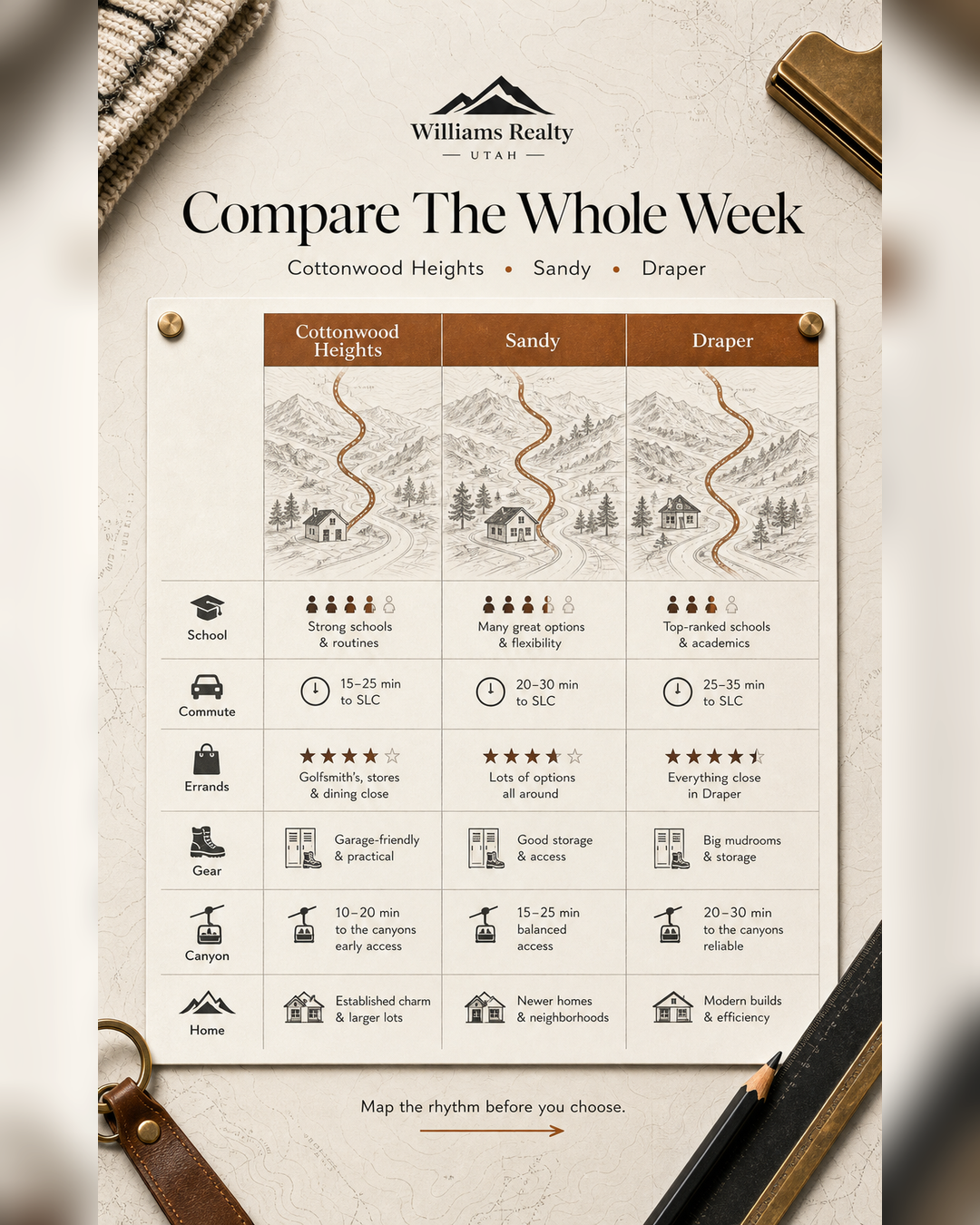
Once you narrow the search to Cottonwood Heights, Sandy, or Draper, pressure-test the decision two ways: how the neighborhood works across a normal week, and how the actual house handles school mornings, gear, guests, commute, and storm cleanup.

Ski-family home comparison FAQs
Is Cottonwood Heights, Sandy, or Draper best for a skiing household?
There is no universal winner. Compare the actual addresses against your chosen resorts, weekday destinations, property function, and dated ownership costs. City names alone do not establish travel time, value, or school eligibility.
Does living near a Cottonwood canyon guarantee a short ski commute?
No. Proximity does not eliminate road closures, traffic, traction restrictions, or resort parking requirements. Check current UDOT and resort information, and keep a delay or cancellation plan.
How should I check ski-bus access before buying a home?
Use UTA’s official Ski Service information to verify the season, route, stop, schedule, and fare. Include travel to the stop and the return journey; do not assume that past service or a nearby stop guarantees the journey you need.
How do I confirm the school assigned to a property?
Ask the applicable district to verify the exact address, attendance boundary, enrollment requirements, program eligibility, and transportation. A mailing city or listing description is not a guarantee of school assignment.
What should I inspect in a home used as a ski base?
Check driveway and access responsibilities, snow removal, drainage, garage clearance, equipment storage, and relevant maintenance records. Use qualified inspectors and property-specific documents instead of assuming a home is winter-ready from its location.
Moving to Utah for Skiing Families: Cottonwood Heights vs. Sandy vs. Draper
How to Choose an Alta or Snowbird Realtor
Evaluate canyon experience, documents, winter function, and diligence.
Read the guide Big CottonwoodBrighton vs. Solitude Real Estate
Compare the ownership model before choosing the resort.
Read the guide SnowbirdBuying a Condo Near Snowbird
Review ownership, HOA, rental, access, financing, and resale questions.
Read the guide