
Before you sell a Utah ski property, know what you actually own
By Jim Williams , Principal Broker/Owner
Before selling a Utah ski property, organize ownership documents, operating costs, pricing evidence, and offer terms. A practical seller preparation guide from Jim Williams at Williams Realty Utah.
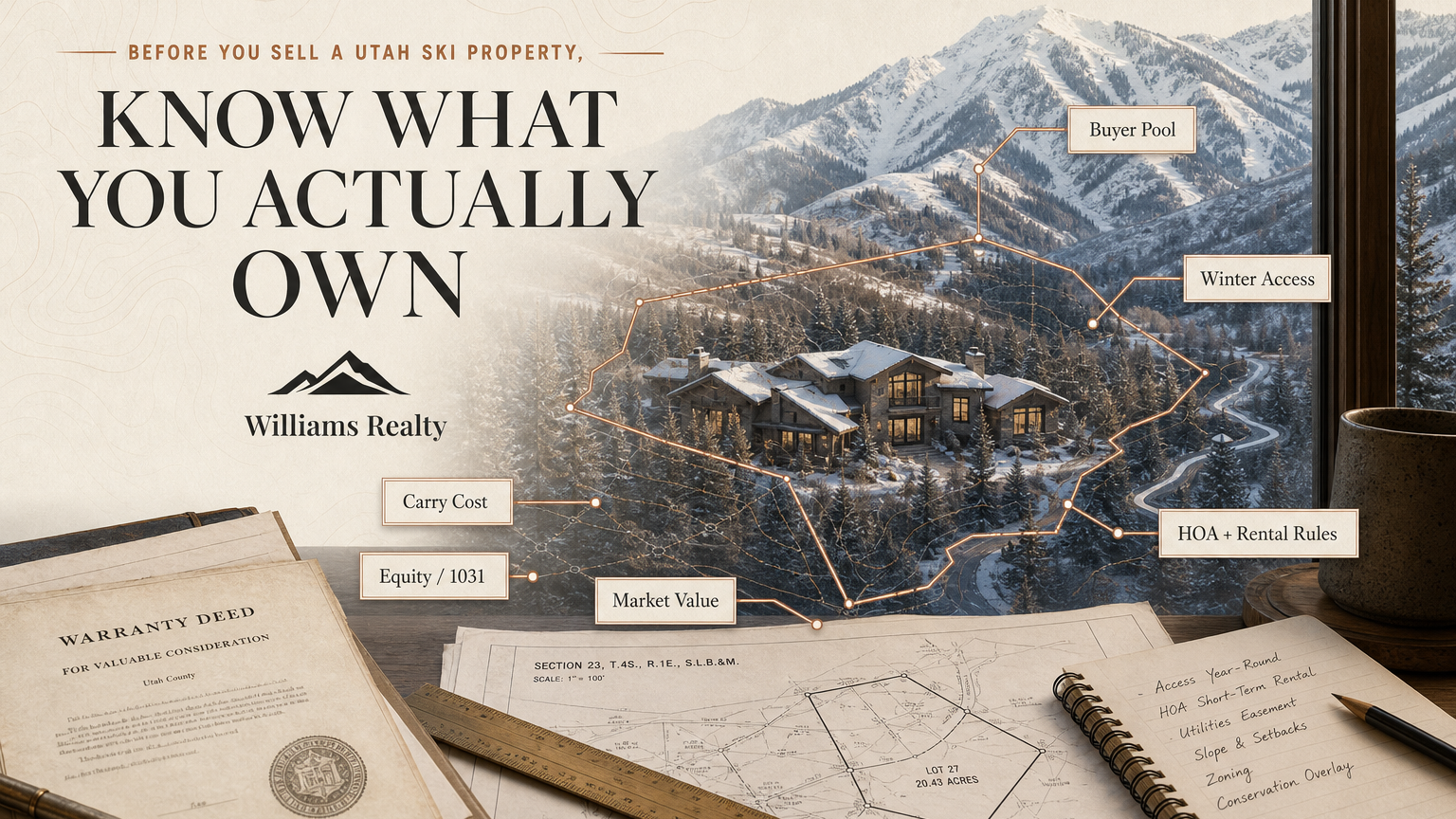
Before selling a Utah ski property, verify the ownership rights, operating obligations, condition, buyer audience, and evidence behind the proposed price. Use those facts to compare selling, preparing, holding, or exploring an exchange with qualified advisers—not just the home’s view or distance to a lift.
A lot of Utah ski-property owners can describe the property perfectly from the inside.
They know which week they usually come out. They know where the skis go. They know which bedroom gets too warm, which restaurant they like after skiing, and what the view looks like when the storm clears.
That kind of knowledge matters. It is part of why people buy these properties in the first place.
But when it is time to decide whether to sell, hold, improve, or exchange, you need a different read.
You need to know what you actually own in the eyes of the market.
That is not always the same thing.
Start with the buyer, not the brochure
The first question I would ask is simple:
Who is the next serious buyer for this property?
Not "Who might like it?" A lot of people like Utah ski property.
The better question is who has the money, motivation, timing, and confidence to write a real offer.
That buyer may be a family relocating for the Cottonwoods. It may be a second-home buyer from California or the East Coast. It may be a Park City investor. It may be a skier who wants Alta and Snowbird access but does not want to live inside resort logistics. It may be someone doing a 1031 exchange who needs the property to make financial sense, not just emotional sense.
Each of those buyers reads the same property differently.
A family may care about schools, garage depth, mudroom flow, dogs, gear, and how the house works on a Tuesday morning.
An absentee owner may care about management, HOA behavior, maintenance, rental rules, and whether the property can be owned from another state without becoming a second job.
An investor may care about carry cost, rental restrictions, personal-use rules, financing, and exit options.
A lifestyle buyer may care most about the feeling.
Your pricing and selling strategy should know which buyer you are really talking to.
"Near skiing" is not specific enough
Utah ski property gets flattened into one phrase: near skiing.
That is too vague to be useful.
Alta and Snowbird are not the same ownership conversation as Brighton and Solitude. Park City and Deer Valley are not the same conversation as Cottonwood Heights, Sandy, or a canyon-mouth home in the Salt Lake Valley.
Even inside the same general area, two homes can live very differently.
One house may have a great view but a difficult winter driveway. Another may not look as romantic online, but it works better for gear, guests, pets, groceries, and storm days. A condo may look easy on purchase price until the HOA, assessments, rental rules, and monthly carry tell a more complete story.
That is why I do not like reducing these properties to distance from a lift.
Distance matters. So does friction.
How does the property work when it is snowing? How is parking handled? Where does wet gear go? What happens if the owner is out of state? Is the HOA helping the asset or becoming part of the drag? Is the buyer pool broad enough, or is this a very specific property that needs a very specific buyer?
Those questions affect value.
Separate enjoyment value from market value
Owners naturally value the property through memory.
The first winter. The kids learning to ski. The guests who came every year. The holiday routine. The view.
There is nothing wrong with that. Real estate is personal.
But the market does not pay you for your memories. It pays for the property, the location, the use case, the condition, and the confidence a buyer feels when they compare it against their other options.
That comparison can be uncomfortable because a property may be deeply valuable to you and still have obvious objections for the next buyer.
Maybe the layout is dated. Maybe the HOA has become expensive. Maybe the rental rules are not as flexible as buyers assume. Maybe the parking is awkward. Maybe the property photographs beautifully but lives less easily in winter. Maybe the buyer pool has changed since you bought it.
The goal is not to talk the property down.
The goal is to separate affection from strategy.
Know your ownership friction
Before selling, I would make a simple list:
What is easy about owning this property?
What is harder than it looks?
That second list matters more than most sellers want to admit.
For a ski property, ownership friction can include HOA costs, maintenance, snow removal, roof and exterior exposure, parking, storage, shuttle or canyon access, management, rental restrictions, insurance, furnishings, turnover, and how often the owner actually uses the place.
If you are local, some friction feels normal because you have learned to manage it.
If the next buyer is out of state, that friction may feel much larger.
If the buyer is doing a 1031 exchange, the friction may affect whether the property works as an investment at all.
If the buyer is a family, friction may decide whether the house supports the lifestyle or just looks like it does.
A good selling strategy names those issues before the buyer does.
Equity is only useful when you know your options
If you have equity in a Utah property, evaluate what choices it creates alongside your costs, needs, and professional advice.
That does not automatically mean they should sell.
It means they should know what choices that equity creates.
For one owner, the right answer may be to hold and enjoy the property with more confidence. For another, it may be a renovation before selling. For another, it may be selling and simplifying. For another, it may be a 1031 exchange into a cleaner investment property.
Those are different strategies.
They require different timing, different preparation, and different advice.
If a sale might involve a 1031 exchange, that conversation needs to start early. The qualified intermediary and tax advisor should be involved before the sale closes, not after a buyer is already picked and everyone is rushing.
I am not giving tax advice here. I am talking about the real estate side of the decision. The structure matters before the listing goes live.
The valuation should explain the story, not just the number
A weak valuation gives you a price.
A useful valuation explains the story behind the price.
It should answer:
- Who is the most likely buyer?
- What will they compare this property against?
- What will they love immediately?
- What will make them hesitate?
- What needs to be fixed, explained, staged, photographed, or disclosed clearly?
- Is the current market rewarding this type of property, or is it more selective right now?
- Is the best strategy to sell now, prepare first, rent, hold, exchange, or revisit later?
That is the conversation owners deserve before they make a decision.
Because selling a Utah ski property is not just putting a mountain photo online and waiting for the right skier to appear.
The best buyers are still making serious comparisons. They are comparing lifestyle, carry cost, access, condition, risk, and long-term fit.
Your property needs to be positioned inside that real decision.
My practical advice
Before you sell, get the property read from three angles.
First, the lifestyle read: who wants this property and why?
Second, the operating read: what does it cost, require, restrict, or simplify?
Third, the exit read: what are your real options if you sell, hold, improve, or exchange?
When those three answers line up, you can make a much better decision.
Not necessarily a faster decision.
A better one.
I am Jim Williams at Williams Realty Utah. This guide focuses on the real-estate decisions behind a ski-property sale; tax, legal, and exchange questions belong with qualified professionals.
If you own a Utah ski property and have not had a serious read on it in a few years, it may be time to look again.
Not because you have to sell.
Because you should know what you actually own.
Build a seller evidence packet before choosing a list price
For a Park City, Deer Valley, Cottonwood Canyon, or valley-base ski property, the useful starting point is a dated evidence file—not a resort label or a county-wide median. Organize the records below before asking an agent to recommend price, preparation, and exposure. Mark each item verified, pending, or not applicable; name who will resolve it and when. This is a preparation framework, not a substitute for required disclosures or professional review.
- Ownership and included rights. Ask the title professional to review the legal description, recorded interests, easements, and exceptions. Match parking, storage, furnishings, and any claimed use rights to the actual documents. Do not describe an assigned space, leased interest, or membership as deeded or transferable without verification.
- Association and project obligations. Request the current governing documents, budget, available reserve information, meeting minutes, insurance materials, and notices of assessments or proposed work. Separate approved obligations from proposals and unanswered questions. Ask the association or manager to confirm transfer procedures and obtain legal advice where interpretation is needed.
- Use, bookings, and management. Assemble leases, bookings, management agreements, and written rental restrictions. Identify the authority governing the exact property and ask about any permits or licenses. A neighbor’s rental listing is not proof of your property’s permitted use; existing bookings and management arrangements may need a transaction-specific resolution.
- Condition and improvements. Gather maintenance records, inspection reports, invoices, warranties, and permit records where applicable. Keep known defects and unresolved questions visible. Have the agent and appropriate professionals identify the applicable disclosure process; this checklist does not decide what the law requires you to disclose.
- Winter operation and owner absence. Document who handles snow, utilities, inspections during vacancy, keys, parking, and emergency coordination. Describe observed property conditions accurately without promising uninterrupted road or resort access. Confirm current public access guidance with the responsible authority.
- Carrying costs and sale costs. Separate dated actual bills from estimates: taxes, insurance, association charges, maintenance, management, utilities, and any transaction-specific obligations. Request a seller net sheet with its assumptions identified. Net proceeds are not a tax calculation or a guaranteed outcome.
Turn the records into a defensible valuation discussion
Ask each prospective listing agent to show why a comparison property belongs in the set. For a Deer Valley condo, a nearby house may share a map label but not the same ownership, services, obligations, or buyer audience. For a canyon property, verified access and operating differences may matter more than a straight-line distance to skiing.
Request a short written explanation covering closed comparable sales, current competing listings, relevant property differences, and what remains uncertain. Listing prices describe the competition’s asking position, not completed sale results. Ask the agent to identify the date and source of the evidence and explain any proposed adjustments rather than copying a broad luxury-market statistic onto your home.
Then separate the preparation decision into three lists: address before marketing, investigate before making a public claim, and offer as-is with appropriate disclosure and pricing advice. Get written scope and estimates for contemplated work. Do not assume a remodel will return its cost or remove a buyer objection until the property’s actual competitive set supports that judgment.
Compare offers by execution as well as headline price
Build the same review sheet for each offer: proposed price and estimated net, financing and appraisal terms, diligence conditions, deadlines, requested repairs or credits, included furnishings, possession, and any rental or management handoff. Have the agent explain the contract and bring legal questions to an attorney. A higher offer can involve different timing or execution uncertainty; no checklist guarantees closing.
If selling may be part of a 1031 exchange, coordinate the real-estate plan with a qualified intermediary and qualified tax and legal professionals before committing to a transaction structure. Eligibility, personal use, timing, and proceeds handling need their review. An appealing ski property is not automatically an eligible replacement, and this article does not promise tax deferral.
Use the right next guide for your decision
- Utah ski and luxury seller representation: compare the agent’s proposed work, pricing evidence, and marketing plan.
- Selling Park City or Deer Valley from out of state: organize access, local responsibility, and remote decisions.
- Park City property and agent-selection guide: investigate the exact property rather than relying on the destination name.
- 1031 ski-property planning: coordinate property diligence with your qualified advisory team.
For official starting points, see the Utah Division of Real Estate’s state-approved forms and the IRS overview of like-kind exchanges. Confirm the current documents and their applicability with the professionals handling your property; neither a general guide nor a search result settles a property-specific right or obligation.
Seller preparation FAQs
What documents should I gather before selling a Utah ski property?
Start with ownership and title records, association documents, leases and management agreements, maintenance and permit records, current operating costs, and a clear list of included furnishings, parking, and storage. Ask the relevant professionals to verify what applies to your property.
How should I compare valuations for a Park City or Deer Valley property?
Ask each agent for dated comparable-sale evidence, current competition, and a written explanation of property-specific differences. A broad market median or nearby asking price is not a substitute for analyzing the same ownership type, condition, obligations, and buyer audience.
Should I renovate a ski property before listing it?
Separate necessary investigation and repairs from optional presentation work. Obtain scope and estimates, then compare the proposal with the actual competing properties and likely buyer objections. Do not assume that renovation costs will be recovered.
Is the highest offer always the strongest offer?
Compare estimated net proceeds, financing, appraisal and diligence terms, deadlines, possession, furnishings, and any rental or management handoff. Ask your agent and attorney to explain the transaction-specific risks; price alone does not determine whether an offer will close.
Can selling a ski property be part of a 1031 exchange?
Possibly, but eligibility, use, timing, and proceeds handling require review by a qualified intermediary and qualified tax and legal professionals. Coordinate them with the real-estate plan before committing to a transaction structure; this guide does not guarantee tax deferral.
Before you sell a Utah ski property, know what you actually own
Confidential and Off-Market Utah Ski Properties
Understand controlled access, limited exposure, and authorized adviser coordination.
Read the guide Seller GuideSell Park City or Deer Valley From Out of State
Build a remote preparation, access, marketing, and closing plan.
Read the guide Investor Guide1031 Exchange Into a Utah Ski Property
Coordinate ski-property diligence with the qualified exchange team.
Read the guide